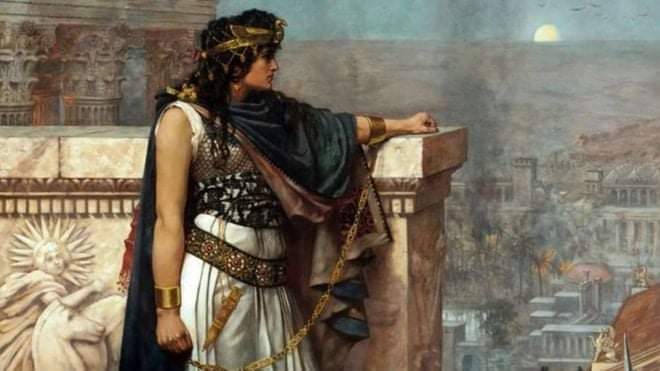
Queen Xenobia, known for her civilization and military prowess, founded the Palmyra Empire, which conquered Syria, Egypt, Anatolia, Palestine, and Lebanon between 268 and 272.
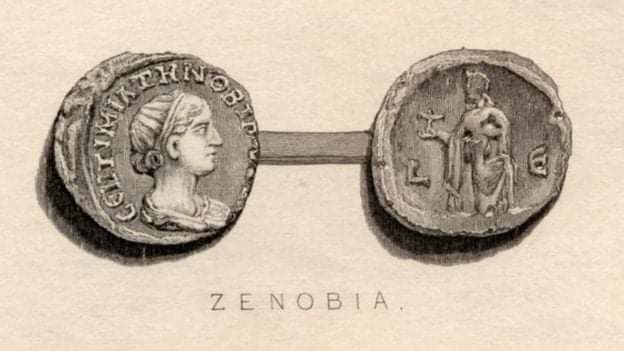
In the year 270, Queen Zenobia proclaimed herself Queen of Egypt and minted coins in Egypt with her image. Queen Zenobia claimed to be Queen Cleopatra’s successor. But Zenobia did not stay in power for long.
Her power was short but she influenced many writers and poets and she has been the subject of many poems and operas.
Xenobia was married to Prince Septimis Odinato of Palmyra, who was well-liked in the Roman Empire for his many successful campaigns against the Persian Empire.
Odinato was made king of Pelmira in 260, thanks to the protection of the eastern frontier of the Roman Empire. But seven years later the king’s nephew killed him and his eldest son and successor Hiran. Heran was from the king’s first wife.
In such a situation, Lucius Lolius, the youngest son of Odinato’s second wife, was enthroned. This younger son became known as Wabalato. Due to Wabalato’s young age, his mother, Zenobia, took over the reins of the kingdom.
She was only twenty-five years old, but she is said to have been extremely polite. Some historians also write that Xenobia’s father was a governor in the Roman Empire. Educated and trained as members of the royal family, she could speak many languages.
It is said that in addition to her beauty, she was also known for her intelligence. There is no doubt that she was very fearless. After her husband’s death, she not only defended Pelmira’s sovereignty but also decided to challenge the Roman Empire.
The new kingdom of Palmyra
Pelmira’s plan to establish a separate empire was initially seen as a protection against the Roman Empire’s alleged Iranian enemies. Odinato himself had made it clear that his aim was to raise the banner of victory to the eastern countries.
Zenobia continued her husband’s plans. He had a strong understanding of military strategy. He not only kept the Persian Empire away but also succeeded in conquering the territories that belonged to the Roman Empire.
Xenobia took advantage of the situation of the critically acclaimed new Roman emperor Claudius II Gothic, who ascended the throne in 268 and was threatened on three sides by the Goths, the Ghuls and the German Germanic tribes.
Rome was conquered, and Zenobia conquered Egypt in 269 and proclaimed herself queen. And thus extended the borders of his kingdom from the Nile to the Euphrates.
Zenobia’s army and people knew her as a ‘warrior queen’. After Egypt, they continued to conquer important Roman cities for trade in the Middle East. However, the arrival of Aureliano after Claudius in 270 thwarted plans to expand Pelmira’s empire.
Aureliano decided to put an end to Zenobia’s imperialist plans. In addition to defeating the Gothic, Ghol, and Germanic tribes, Oliniano recaptured Egypt and decided to raise the Roman flag in the east again.
One by one, he gained control of all the territories occupied by Zenobia’s troops. The queen had to withdraw her troops and hide in Palmyra. But Aureliano was not one of the losers. He surrounded Palmyra and prevented foreign objects from entering the city.
Meanwhile, in 272, Zenobia and her son tried to flee the Persian Empire, but both were captured and taken to Rome. In Rome, the king held a victory procession in which both prisoners were displayed.
There are different stories about what happened next. According to the most popular legend, Aureliano forgave them and allowed them to live in exile in the northeastern Roman city of Tibor (now Touli).
According to this story, Zenobia became known as one of the best philosophers in the high society of Rome.
During his reign, Zenobia added four moons to the beauty of Palmyra. Palmyra has been famous for its beautiful buildings, statues and gardens.
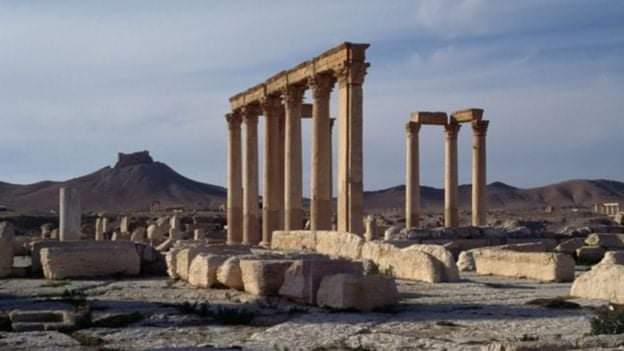
The ruins of Palmyra, now in the Syrian province of Homs, are a World Heritage Site, but these historic structures have suffered severe damage.
The beauty and historical significance of Palmyra has been preserved throughout history. In Syria, the city’s ancient structures are of great tourist importance. In 1980, Palmyra was declared a World Heritage Site by UNESCO.
However, the city was captured several times and severely damaged. After the fall of the Pelmira Empire and the failed attempts of the rebels, the Roman rulers captured Pelmira, the first occupation.
Valuables and treasures were taken from Palmyra to Rome. Even in modern times, Palmyra suffered heavy losses. In 2015, the Islamic State militant group seized the city during the Syrian civil war, severely damaging its buildings and ancient structures.
Numerous historic statues and buildings in the city were destroyed by explosives as symbols of idolatry. However, after regaining control of the city, the Syrian government said that despite severe damage, several important and ancient structures of the city were preserved.
 @Khan
@Khan 